


The megatrend of Intelligent Automation—driven by systems like AI, Digital Twins, and the Internet of Things (IoT)—is fundamentally changing the face of business. Business leaders need to contend with more than a systems update; it involves a profound challenge that is forcing organisations to reconsider their very operating models and business models. An AI strategy involves more than providing staff members safe access to ChatGPT, but a holistic and systematic review of their business plan and growth thesis.
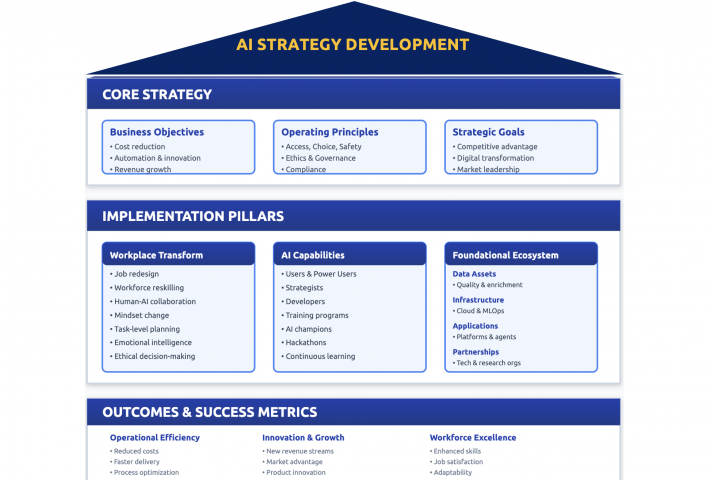
Aligning AI with Business Objectives. A strong strategy must first address core business imperatives, such as rising costs, manpower constraints, or the need for more effective innovation. AI is strategically deployed to achieve concrete goals, including automating production processes to free up staff for higher value work, personalising the customer experience, optimising workflows, or creating new revenue streams by monetising previously untouched data.
Operating Principles. Successful adoption needs to be guided by a set of principles to navigate trade-offs in line with the unique priorities of different organisations. For example, an innovation-centric organisation might prioritise Inclusive Access, placing in the hands of all employees for experimentation and creation. A diverse, people-centric organisation might place a high importance on Choice, offering a variety of tools for different use cases. Another risk-averse organisation, perhaps operating in a tightly-regulated environment, might emphasise Safety, ensuring rigorous ethical evaluation and policy compliance. Issues around AI ethics and data governance such as privacy, consent, transparency, or explainability also need to be addressed, mitigating critical risks such as algorithmic bias, security breaches, or intellectual property concerns.
Transforming the Workplace. As intelligent automation gathers momentum, the way work is done shifts, moving from tasks delivered predominantly by humans to those delivered by technology or through human-machine collaboration. This transition requires updating existing operating models and job designs. Organisations must engage in strategic intervention to define and develop the skillsets of the future suitable to their respective sectors, and deploy them in new, AI-augmented job roles. Manpower planning must now operate at the task level, incorporating workforce reskilling, job redeployment, and a necessary mindset change among the entire workforce. To complement new skills in digitalisation, prompt engineering skills, cyber-risk, as well as data governance and AI ethics, organisations also need to intentionally identify, measure, and nurture critical competencies such as emotional intelligence, conflict resolution, ethical decision-making, and relationship building.
Building AI Capabilities. Developing internal AI expertise is paramount. Many organisations are setting targets to train various levels of staff in different types of AI competency, ranging from Users and Power Users, to Strategists and Developers. Empowering internal teams requires fostering a culture of continuous learning and experimentation. Good practices to develop internal AI competencies include establishing strong internal training and development programs; setting up accessible, secure central web applications for staff to access and experiment with various models and toolkits; identifying and empowering internal AI champions across departments; organising cross-departmental competitions, hackathons or coaching sessions to drive awareness and incidental learning while demonstrating AI value by solving business problems.
Foundational Ecosystem. Underpinning this strategic shift are several essential components. (i) Data Strategy. Data is the integral resource from which AI extracts intelligence. A dedicated study must be conducted to map all data assets—raw, metadata, and processed—to ensure high quality, improved access, and efficient enrichment for AI models. (ii) Scalable Infrastructure. Reliable AI operations demand working with IT teams to build scalable compute resources (like cloud clusters) and standardize operations using frameworks like MLOps, ensuring smooth and fast project delivery. (iii) Interfaces and Applications. Beyond providing staff access to AI, a back-end platform may be necessary to seamlessly connect diverse internal and external AI models with enterprise systems, encouraging open innovation. This infrastructure supports new tools which power autonomous AI agents that perform specific tasks. (iv) Strategic Partnerships. Cultivating an external ecosystem through partnerships with technology providers, research institutions, and industry experts ensures the organization remains state-of-the-art as AI capabilities continue to evolve rapidly.
Ultimately, an AI strategy is not a standalone project; it is part of a broader, integrated strategy that leverages new human capabilities, operating models, workflows and data stream, infrastructure investments, and data. By defining clear objectives, committing to ethical principles, and actively transforming the workforce, organisations can successfully adapt and thrive in a competitive digital future.